A Widow Was Asked to Give Up Her Inheritance. Here's Why Every Muslim Needs a Wasiat
The funeral was over.
The family was still grieving.
Then the inheritance discussions began.
Within days, a widow was being pressured to give up the share that Islam had already given her.
Sadly, situations like this are more common than many Muslims realise.
This isn't a story about a family that hated each other.
It's a story about what can happen when there isn't enough estate planning before someone passes away.
A Family Already Grieving
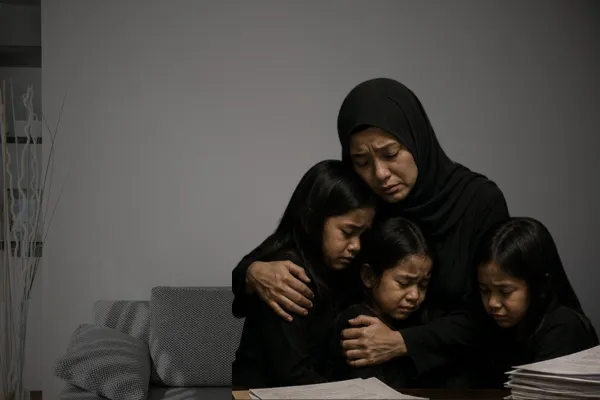
A Muslim man passed away unexpectedly, leaving behind:
His wife
Three young daughters
One brother
Two sisters
Like many families, they were trying to come to terms with their loss.
But before they had the chance to grieve, conversations about the estate began.
Unfortunately, those conversations quickly turned into pressure.
What Does Faraid Say?
Under Islamic inheritance principles, the estate would generally be distributed as follows:
Many Muslims are surprised by this.
A common misconception is that once a person has children, siblings automatically receive nothing.
That isn't always the case.
When the deceased leaves only daughters and no sons, certain siblings may still inherit the remaining balance of the estate under the rules of Asabah.
This is one of the reasons why understanding Islamic estate planning is so important.
Then Came the Pressure
The widow was invited to meet the deceased's siblings.
During the meeting, an affidavit was placed in front of her.
She was asked to sign away her inheritance.
The explanation sounded reasonable.
"It will make managing the estate easier."
But what it really meant was something very different.
If she signed, she would lose the inheritance that Islam had already entitled her to receive.
More importantly, she would weaken her ability to safeguard the interests of her three young daughters, who together were entitled to two-thirds of the estate.
This Was Never Just About 12.5%
Some people see the widow's share as "only" 12.5%.
But that percentage represented far more than money.
It represented:
Financial security after losing her husband
Stability for her family
A roof over her children's heads
A voice in how the estate would be administered
As the only surviving parent, she was also responsible for protecting the inheritance belonging to her three underage daughters.
Giving up her own rights could make protecting theirs much more difficult.
Can Someone Be Forced to Give Up Their Inheritance?
The short answer is no.
No beneficiary can be legally forced to surrender a Faraid entitlement through intimidation, emotional pressure or coercion.
If someone signs a legal document under duress, its validity may be challenged.
When minor children are involved, the courts are also likely to place their welfare first and ensure that their inheritance is properly protected.
Family pressure does not override legal rights.
The Bigger Lesson
This story isn't really about difficult relatives.
It's about what happens when a family is left without enough clarity after someone passes away.
Grief already places an enormous emotional burden on those left behind.
Without proper planning, misunderstandings can quickly become disagreements.
Disagreements can become disputes.
And disputes can leave lasting scars on family relationships.
Many Muslims assume a Muslim Will (Wasiat) is only necessary for wealthy families.
That couldn't be further from the truth.
Whether your estate is worth $50,000 or $5 million, proper planning helps the people you love navigate one of the most difficult periods of their lives with greater certainty.
How a Proper Wasiat Can Help
A professionally prepared Wasiat does not change the fixed inheritance shares determined by Faraid.
Instead, it complements the Islamic inheritance process by providing important guidance that Faraid does not address.
Depending on your circumstances, a properly drafted Islamic Will can help:
Appoint trusted executors to administer your estate
Record your funeral wishes
Document your debts and financial obligations
Make permissible gifts according to Islamic principles
Reduce uncertainty among surviving family members
Support a smoother estate administration process
Most importantly, it helps your loved ones understand your intentions before disagreements have a chance to arise.
Estate Planning Is an Act of Responsibility
Many Muslims delay writing a Wasiat because they feel they're still young, healthy or believe Faraid alone will solve everything.
Unfortunately, life doesn't always give us the opportunity to prepare later.
A proper Muslim estate plan isn't about changing Allah's laws.
It's about making it easier for your family to carry out those laws with clarity, fairness and confidence.
That may be one of the greatest gifts you ever leave behind.
Frequently Asked Questions
Do I still need a Wasiat if Faraid already determines inheritance?
Yes.
Faraid determines who inherits and how much they inherit.
A Wasiat helps provide practical instructions for administering your estate and can reduce confusion during the estate administration process.
Can a widow be forced to give up her Faraid share?
No.
No beneficiary should be pressured or forced to waive their inheritance rights. Any decision to renounce an inheritance should be made voluntarily and with independent legal advice.
Why is estate planning important if my children are still young?
Minor children cannot manage their inheritance themselves.
Proper Islamic estate planning helps ensure their interests are protected while the estate is being administered.
Is a Muslim Will only for wealthy families?
No.
Every Muslim leaves behind responsibilities, assets, debts and loved ones.
A Wasiat provides clarity regardless of the size of your estate.
Need Clarity About Your Family's Situation?
Every family's circumstances are different.
The way your estate will be administered depends on many factors, including your family structure, the assets you own, and whether you've already put arrangements such as a Wasiat in place.
If you're unsure how Islamic inheritance applies to your situation, we're here to help.
At Modern Muslim Finance, we help Muslims in Singapore understand their options and prepare their estate according to Islamic principles.
We offer a complimentary first consultation with absolutely no obligation.
It's simply an opportunity to ask questions, understand your situation, and gain clarity on the steps you may wish to take to protect your loved ones.
Whether you're considering writing your first Muslim Will, updating an existing Wasiat, or simply want to understand how Faraid applies to your family, we're happy to guide you.
Book your complimentary consultation today and take the first step towards protecting your family's future with confidence.


