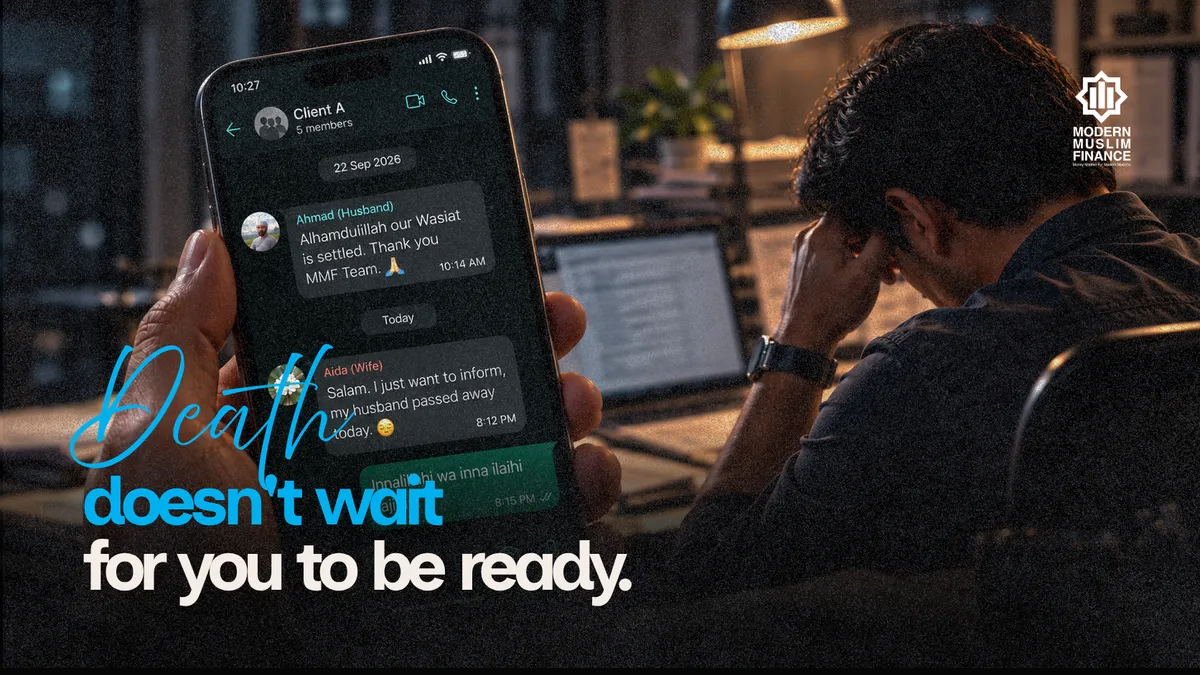
We Talk About Death Every Day. Here's What We've Learned.
Death isn't something most people talk about every day.
At Modern Muslim Finance, it's different.
Day after day, week after week, we speak to families about what happens when someone passes away.
Sometimes, it's a client we've been helping for months.
Sometimes, it's someone who contacted us just a few days earlier.
And sometimes, it's someone who was planning to come back to us...
but never got the chance.
These aren't hypothetical situations to us.
We've seen what happens when a family has their Wasiat in Singapore properly prepared.
We've also seen what happens when a family is suddenly forced to deal with Muslim inheritance without having had the opportunity to prepare.
Over time, we've learned something that we wish more people understood:
You don't get to choose when you're ready.
Death doesn't wait until your children grow up.
It doesn't wait until you have finished paying off your home.
It doesn't wait until you've sorted out your documents.
And it certainly doesn't wait until you've finally said:
"Okay, I think I'm ready to do my Wasiat."
We've seen this happen too many times.
Here are three stories that have stayed with us.
"Everything Was Ready."
There was a couple who came to us to prepare their Wasiat.
They took the time to sit down, have the conversations, make the necessary decisions and put everything in place.
Their Wasiat was completed.
Everything was ready.
Then, about two months later, the husband's wife sent us a message.
Her husband had passed away.
Just like that.
There was no long period to prepare.
No warning that gave the family months to get everything sorted.
He was simply gone.
But there was something different about this family.
They had already planned.
So when the wife contacted us, we weren't starting from zero.
We already had the relevant information.
We already understood their situation.
The Wasiat was in place.
We could guide her through the next steps and explain what needed to happen.
Instead of the family having to scramble to figure everything out while dealing with grief, there was already a plan to work from.
And that made a difference.
The family still had to deal with the pain of losing someone they loved.
A Wasiat doesn't take that pain away.
But it can remove some of the uncertainty that comes with it.
For the wife and family, having everything prepared gave them one less thing to worry about during an incredibly difficult period.
That's one of the reasons we keep telling people:
Planning isn't about expecting death.
It's about making things easier for the people you leave behind.
"My Husband Had a Minor Stroke. I Want to Prepare His LPA."
Another case started very differently.
A wife contacted us because her husband had recently experienced a minor stroke.
He was still well enough to make his own decisions.
She understood that there was a limited window to put certain arrangements in place.
One of the things she wanted to do was set up a Lasting Power of Attorney (LPA).
She also wanted to prepare their Wasiat.
It was a sensible decision.
They had experienced a health scare.
They didn't want to wait for another one before getting their affairs organised.
So we started helping them.
Then, just three days later...
Her husband suffered another stroke.
This time, things were different.
He became bedridden.
The situation changed almost overnight.
The window they thought they had suddenly became much smaller.
We continued to support his wife in whatever ways we could.
But this experience reinforced something important for us:
When it comes to estate planning and an LPA, timing matters.
An LPA isn't something you should think about only when someone is already seriously incapacitated.
For an LPA to be made, the person must still have the mental capacity to make the decision and understand what they're doing.
That's why waiting until a crisis happens can create unnecessary complications.
The same principle applies to your Wasiat.
Don't wait for a health scare to force the conversation.
Have it while you're healthy.
Have it while you're able to make your own decisions.
Have it while you still have time.
"I'll Get Back to You."
This is probably the hardest story for us to talk about.
Because it happened recently.
A husband contacted us.
He told us that he thought he was finally ready to prepare a Wasiat together with his wife.
They had their first consultation with our team.
We sat down with him.
We discussed his situation.
We started understanding what he needed.
At the end of the consultation, he told us he wanted to discuss it with his family first.
That's completely understandable.
Estate planning involves important decisions.
Sometimes you need time to speak to your spouse.
Sometimes you want to talk to your parents or children.
Sometimes you simply want to think about it.
So we told him to get back to us when he was ready.
Seven days later...
His wife contacted us.
Her husband had passed away suddenly.
We were shocked.
Our team had just spoken to him.
We had just started the conversation.
And now he was gone.
There was no opportunity to finish what we had started.
No second consultation.
No final review.
No chance for him to say:
"Okay, let's proceed."
At that point, there was nothing we could do to complete his Wasiat.
But there was still a grieving wife who needed support.
So we did what we could.
We listened.
We helped calm her down.
We explained what we could.
And we tried to guide her towards the next steps.
But honestly?
That conversation stayed with our team.
Because it reminded us of something we sometimes forget:
"I'll do it later" assumes there will be a later.
There isn't always one.
Death Doesn't Give You a Deadline
We don't share these stories to scare you.
We share them because they're real.
And because these are situations our team has personally encountered.
When you're healthy, death feels distant.
When you're busy with work, children, bills, school and everything else happening in life, preparing a Muslim Will in Singapore can easily become something you keep postponing.
"I'll do it next month."
"Let me sort out my finances first."
"I'll do it when the children are older."
"I'll talk to my spouse first."
"I'm still young."
And sometimes...
there is no next month.
The uncomfortable truth is that death doesn't care whether your paperwork is ready.
It doesn't care whether you've found the right Wasiat provider.
It doesn't care whether you've had time to speak to your family.
It simply happens.
What you can control is what you leave behind.
Wasiat, Faraid and LPA: Different Tools for Different Needs
It's also important to understand that estate planning isn't just about writing a Wasiat.
Different tools serve different purposes.
Wasiat
A Wasiat is an important part of Islamic estate planning for Muslims.
It can provide important instructions and help your family understand what needs to be done when you pass away.
It works alongside Muslim inheritance law in Singapore, including the principles of Faraid.
Faraid
Faraid determines how a deceased Muslim's estate is distributed among eligible beneficiaries according to Islamic inheritance principles.
Understanding Faraid is therefore an important part of understanding your estate.
But knowing how Faraid works doesn't mean your family automatically knows how to administer your estate.
There is still practical work to be done.
Lasting Power of Attorney
An LPA serves a different purpose.
It allows you to appoint someone you trust to make decisions on your behalf if you lose mental capacity while you're still alive.
It isn't a replacement for a Wasiat.
And a Wasiat isn't a replacement for an LPA.
They address different situations.
That's why proper planning should look at your circumstances as a whole rather than simply asking:
"Do I need a Wasiat?"
The better question is:
"What does my family and I need to have in place?"
What We Do at Modern Muslim Finance
At Modern Muslim Finance, our goal has never been simply to sell a Wasiat.
We want to help Singapore Muslims understand what they need to prepare for.
Sometimes that means helping someone write their Wasiat.
Sometimes it's helping someone understand Faraid.
Sometimes it's explaining the importance of an LPA.
And sometimes, it's simply giving someone the information they need to make a better decision.
That's why we've created resources to help Muslims start learning before they're ready to engage a consultant.
Our Guides
A resource to help Muslims better understand Islamic inheritance and Faraid.
A practical resource explaining what a Lasting Power of Attorney is and why it matters.
Helping Muslims better understand their Zakat obligations.
A practical guide covering what families need to know and do when a Muslim loved one passes away.
These resources are there because education comes first.
You don't need to speak to us immediately.
Start by learning.
Understand your situation.
Talk to your spouse.
Ask questions.
Then decide what you need to do.
We Also Run Monthly Wasiat & Faraid Planning Classes
For those who want to understand the bigger picture, we also conduct our Wasiat & Faraid Planning classes regularly.
The goal isn't simply to tell you:
"Go and write a Wasiat."
It's to help you understand why estate planning matters, how Faraid works, what happens after someone passes away, and what you can do while you're still alive to make things easier for your family.
Because we believe an informed Muslim family makes better decisions.
And If You're Ready, We'll Help You Figure Out What's Right for You
Maybe you've been thinking about writing your Wasiat for months.
Maybe you've already downloaded an LPA guide.
Maybe you have children now and suddenly realise your responsibilities have changed.
Or maybe one of the stories above made you stop and think:
"I really shouldn't keep putting this off."
If you're ready to explore your options, speak with one of our consultants.
You don't have to know exactly what you need before you contact us.
That's what the consultation is for.
We'll first understand your situation, your family circumstances and what you're trying to achieve.
From there, we'll recommend the option that is suitable for you and explain the fees involved clearly.
There's no obligation to proceed.
No pressure.
Just a conversation to help you understand where you stand and what you may need to put in place.
Because ultimately, estate planning isn't really about death.
It's about the people who have to live with what you leave behind.
And if there's one thing these experiences have taught us, it's this:
Don't wait until you're ready. Get ready while you still can.


